


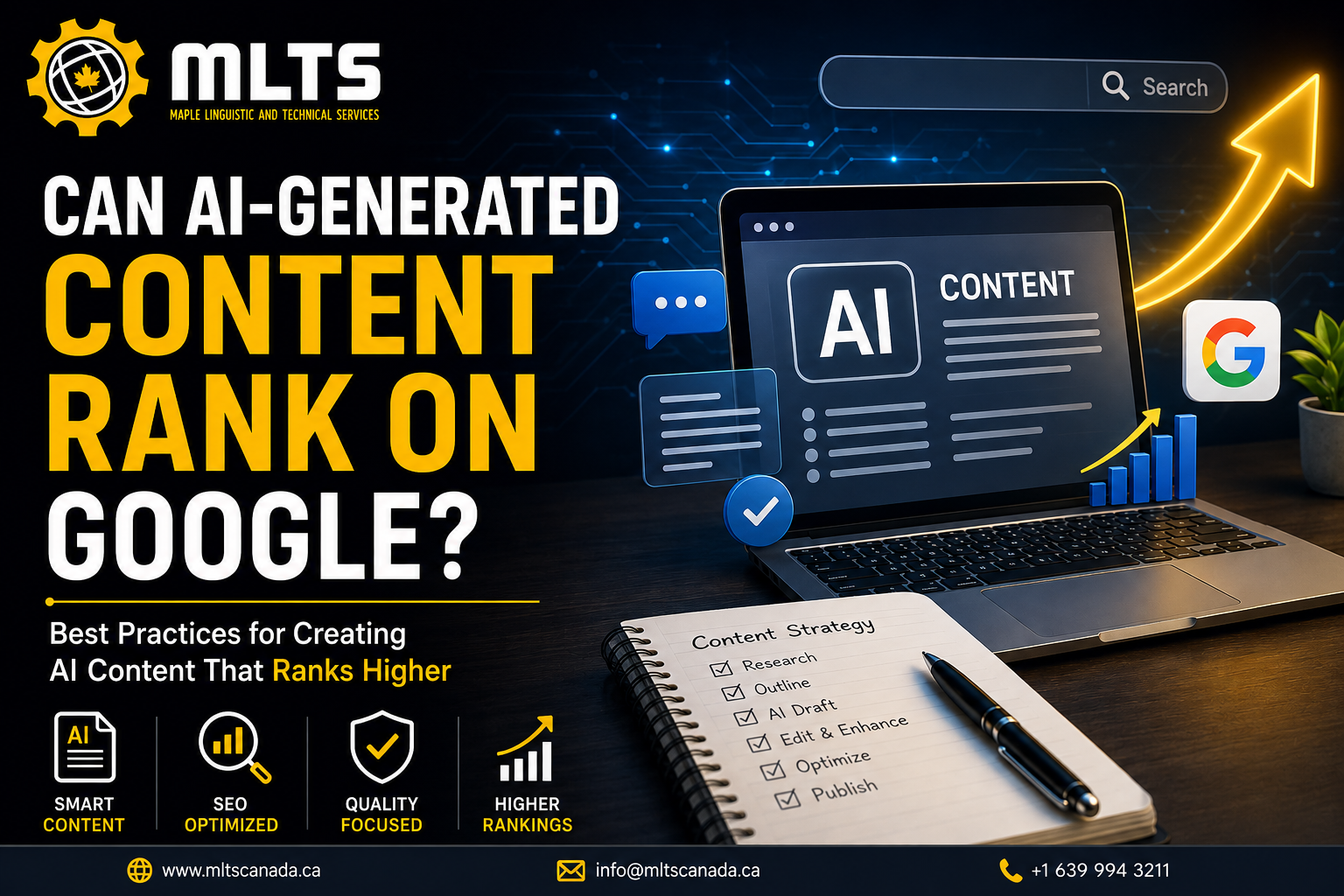
Artificial intelligence has changed the way businesses create digital content. From blog articles and landing pages to product descriptions and email campaigns, AI-powered tools help marketers produce content more efficiently than ever before.
But one important question remains:
Can AI-generated content rank well on Google?
The answer is yes, but only when it’s created with quality and user value in mind.
Google doesn’t judge content based on whether it was written by a person or generated with AI. Instead, it focuses on whether the content is helpful, accurate, relevant, and satisfies the user’s search intent. Businesses that use AI responsibly can improve productivity while maintaining strong search engine performance.
In this guide, MLTS Canada explains what works, what should be avoided, and the best strategies for creating AI-generated content that performs well in search results.
Google’s View on AI-Generated Content
Google’s primary goal is to deliver useful and reliable information to users. Its ranking systems evaluate the overall quality of content rather than the method used to create it.
Whether content is written manually or generated with AI, it should:
- Provide clear answers to users’ questions
- Demonstrate expertise and credibility
- Contain accurate and up-to-date information
- Offer original insights or practical value
- Deliver a positive reading experience
This means businesses can confidently use website content by AI as long as every piece is reviewed, improved, and created with the user in mind.
What Works with AI-Generated Content?
Use AI for Research and Planning
AI tools are excellent for speeding up the content planning process.
They can help you:
- Generate content ideas
- Build article outlines
- Suggest relevant keywords
- Identify common search queries
- Organize topics efficiently
This allows marketers to spend less time researching and more time adding valuable insights that make content unique.
Create High-Quality First Drafts
One of AI’s biggest advantages is producing draft content quickly.
Businesses can use AI to:
- Publish content more consistently
- Save time during content creation
- Scale content marketing efforts
- Improve workflow efficiency
However, AI-generated drafts should always be treated as the first step rather than the finished article.
Improve SEO Optimization
Modern AI writing tools can also support several on-page SEO tasks, including:
- Natural keyword placement
- Optimized title tags and meta descriptions
- Proper heading hierarchy
- Readability improvements
- Internal linking suggestions
When combined with human editing, AI generated content for SEO can contribute to stronger search visibility and better user engagement.
Refresh Existing Content
Updating older content is often more effective than constantly creating new pages.
AI can assist by:
- Refreshing outdated information
- Expanding thin content
- Improving readability
- Adding FAQs
- Enhancing page structure
Regular content updates help maintain relevance and improve long-term rankings.
What Doesn’t Work with AI Content?
Publishing AI Content Without Editing
One of the most common mistakes is publishing AI-generated text without reviewing it.
Unedited content may contain:
- Incorrect facts
- Generic information
- Repetitive wording
- Poor context
- Weak readability
Human review is essential for improving accuracy, clarity, and credibility.
Producing Large Volumes of Low-Quality Content
Publishing hundreds of AI-written pages doesn’t guarantee better rankings.
Google continues to reward websites that focus on quality rather than quantity.
Low-value content can result in:
- Reduced user engagement
- Lower trust
- Poor search performance
- Higher bounce rates
A smaller number of high-quality articles is far more valuable than a large collection of weak pages.
Ignoring E-E-A-T
Google places significant importance on Experience, Expertise, Authoritativeness, and Trustworthiness (E-E-A-T).
While AI can generate information, it cannot replace real-world knowledge or professional experience.
Adding expert opinions, industry examples, and practical insights makes your content more credible and valuable.
Keyword Overuse
Some AI tools repeat keywords too frequently in an attempt to improve rankings.
This creates unnatural content that is difficult to read and provides a poor user experience.
Instead, keywords should be included naturally while maintaining smooth, informative writing.
How to Rank Higher with AI-Generated Content
Combine AI with Human Expertise
The strongest-performing content combines AI efficiency with human knowledge.
Improve AI-generated articles by including:
- Real-life examples
- Industry experience
- Case studies
- Professional recommendations
- Original observations
These additions make your content more trustworthy and engaging.
Understand Search Intent
Before creating content, identify what your audience is actually looking for.
Ask questions such as:
- Are users seeking information?
- Are they comparing products or services?
- Are they ready to make a purchase?
Content that matches user intent consistently performs better in search engines.
Deliver Original Value
AI often generates information that’s similar to existing online content.
To stand out, include:
- Original research
- Company insights
- Practical solutions
- Actionable advice
- Unique perspectives
Originality remains one of the most effective ways to improve rankings.
Optimize Every Page
Even outstanding content requires proper SEO optimization.
Each article should include:
- Keyword-focused title tags
- Compelling meta descriptions
- Well-structured headings
- Internal links
- Optimized images
- Fast-loading pages
Technical optimization helps search engines better understand your content.
Verify Every Fact
AI tools may occasionally generate outdated or inaccurate information.
Always review:
- Statistics
- Industry updates
- References
- Technical details
- Dates and factual claims
Accurate content builds trust with both users and search engines.
Best Practices for Using Website Content by AI
Do
- Use AI to brainstorm ideas and create outlines.
- Edit every article before publishing.
- Add expert insights and real examples.
- Write with user intent in mind.
- Keep content updated regularly.
- Follow SEO best practices.
Don’t
- Publish AI-generated content without review.
- Create content only for search engines.
- Overuse keywords.
- Depend entirely on automation.
- Ignore quality assurance.
The Future of AI Content and SEO
Artificial intelligence will continue to transform content marketing, making content creation faster and more efficient. However, Google’s objective remains unchanged: providing users with the most helpful, trustworthy, and relevant information.
Businesses that succeed with AI will use it as a productivity tool rather than a replacement for human expertise. Combining AI-generated content with professional editing, SEO knowledge, and genuine industry experience creates content that delivers lasting value and stronger search performance.
Working with an experienced digital marketing agency like MLTS Canada ensures AI-generated content aligns with modern SEO standards while supporting long-term business growth.
Final Thoughts
AI is a powerful content creation tool, but it isn’t a shortcut to higher rankings.
The most successful strategy is to combine AI-generated drafts with human expertise, thorough editing, and proven SEO techniques. When used responsibly, website content by AI can improve productivity, support consistent publishing, and strengthen your online visibility.
By focusing on quality, originality, and user experience, businesses can confidently use AI generated content for SEO and build content that performs well in today’s competitive search landscape.